
You Do You
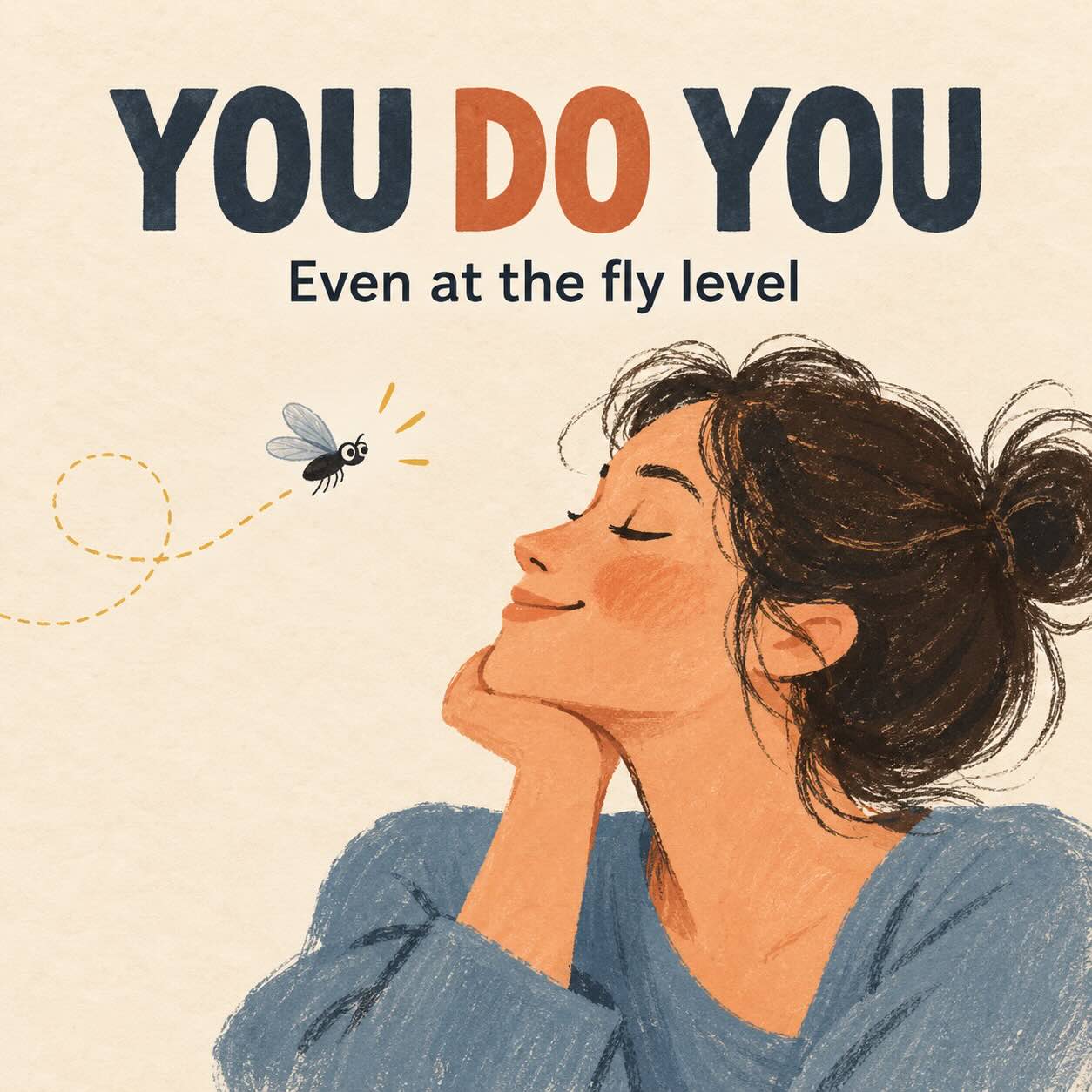
You Do You
(Even at the Fly Level)
How much energy do we spend trying to get other people to behave differently? I suspect the answer, for most of us, is more than we realize. We just happen to have some very strong feelings about how certain things should go. How people should behave. How situations should turn out. How quickly someone should respond. How the dishwasher should be loaded. You know, reasonable things.
I’ve been thinking about this lately because of something a friend said that has become a bit of an experiment among us: “You do you.” Recently, at one of our monthly gatherings, my friend, we will call her Samatha, shared a story about noticing where her attention goes and becoming more conscious about where she chooses to place it because often, she could hear her thoughts leaning toward ‘trying to’ control the world around her. She told us about playing guitar at a recent church service when a fly began buzzing around her. She couldn’t exactly stop playing to swat at it, and then, because apparently buzzing wasn’t intrusive enough, it landed on her lip.
Her lip. God forbid.
But rather than launching into some modified Mr. Miyagi “wax on, wax off” maneuver in the middle of the service, she heard herself think, “You do you.” She didn’t fight with the fly or become particularly agitated by it. She simply let it be a fly. Interestingly, it quickly left her and moved on to someone else in the congregation, who promptly began batting at it.
We laughed about this, and her perceived ‘powers of persuasion”, but those three little words stayed with me. You do you.
There is something wonderfully freeing about them. Not resignation exactly, and certainly not permission for other people to hurt us, behave badly, or cross important boundaries. It’s more of a softening around our insistence that other people, circumstances, and apparently insects need to behave differently in order for us to be okay.
I’ve started thinking of this as acceptance at the fly level. It’s relatively easy to be philosophical from a distance. I can understand that people have different histories, personalities, fears, values, and ways of moving through the world. I can hold all kinds of generous thoughts about humanity from 10,000 feet. But what about when humanity is buzzing three inches from my face? What happens when someone cuts me off in traffic, sends that email, disappoints me, misunderstands me, or simply does something completely differently than I would? That’s the fly level. Real time. Up close. And suddenly my enlightened 10,000-foot self has some opinions.
There is some good psychology behind this. Ford and colleagues (2018) examined what happens when people are more accepting of their thoughts and emotions rather than immediately judging, avoiding, or struggling against them. They found that greater acceptance was associated with lower negative emotional responses to everyday stressors and, over time, better psychological health. In fact, the researchers suggest that acceptance may help by reducing our tendency to react to and further intensify already difficult internal experiences (Ford et al., 2018).
Acceptance can be difficult, even if it does offer lasting health benefits. What happens is an original experience is unpleasant. But then, our brains add another layer, or three.
The fly buzzes.
Then we get irritated that the fly is buzzing.
Then we decide the fly should not be buzzing.
And now we’re in a relationship with the fly.
This is where acceptance plays a potential role, before the layers of frustration lead to unhealthy mental intrusions. Ford and colleagues found that people who were more accepting of their internal experiences tended to have less negative emotional responses when stressful things happened. The researcher also found that people in their daily-life study exhibited a pattern associated with better psychological health up to six months later. Put another way, practicing internal acceptance may not only protect us from current stress, but it may also inoculate us against the risks of future stressors!
That doesn’t mean we simply must accept everything that happens around us. Instead, we might draw upon the idea of workability. Rather than getting stuck on whether our reaction is justified, and sometimes it absolutely is, we can ask a slightly different question:
Is what I’m doing with this actually working? Is my response helping? Is it moving me toward the person I want to be or the outcome that matters? Or am I now spending enormous amounts of energy trying to make a fly stop being a fly?
Which brings me to my other friend. After hearing Samantha’s story, Darlene decided to try this “you do you” idea. In her experiment, a mosquito landed on her arm. She didn’t want to kill it, so she informed it that the door was open and encouraged it to leave. Apparently unmoved by her hospitality, it hung around. Finally, she tried the magic words: “You do you.” And it flew away.
Success! Until later, when she discovered that although it hadn’t bitten her arm, it had bitten her in two other places. We laughed at this with conviction, but upon reflection…the mosquito may have understood the assignment better than we did.
Acceptance isn’t a bargain. We don’t get to say, “Okay, I’ll stop trying to control you, but in return I’d like you to behave according to my preferences.”
That’s still control.
The mosquito did exactly what mosquitoes do.
And perhaps this is where you do you becomes less about the other person (or insect) and much more about us. I can allow you to be who you are without surrendering my ability to decide who I want to be in response.
That doesn’t mean becoming passive. There are times when the workable response is to speak up, leave, solve the problem, set a boundary, have the difficult conversation or, frankly, swat the mosquito.
But not every fly requires a fight. And maybe that’s my invitation as we move into October. Notice what is buzzing around you. Notice what you are trying particularly hard to make different. And before automatically swatting, fixing, convincing, correcting, defending or controlling, perhaps ask: Is what I’m doing with this actually workable? Can I allow this person, situation, thought, feeling (or very persistent insect) to be what it is while I decide what I want to do?
Sometimes the answer will be to act. And sometimes, perhaps, we can loosen our grip and offer three surprisingly liberating words: You do you.
Just remember, if you’re saying it to a mosquito, all bets are off.
Ford, B. Q., Lam, P., John, O. P., & Mauss, I. B. (2018). The psychological health benefits of accepting negative emotions and thoughts: Laboratory, diary, and longitudinal evidence. Journal of Personality and Social Psychology, 115(6), 1075–1092. https://doi.org/10.1037/pspp0000157