
June Founder’s Corner: Hello Beautiful Self – A Parent’s Guide to a Healthier Summer

Summer once meant long stretches of open time—bike rides around the neighborhood, running through sprinklers, building forts, and negotiating boredom with little more than a popsicle and a friend with a slightly better imagination. For those of us who grew up in the 1980s or earlier, that freedom came with a subtle gift: we learned how to be alone with ourselves. We had to create something out of nothing. No curated feeds, no constant pings, no pressure to be productive, just time, space, and a slowly forming not yet discovered, yet completely beautiful sense of Self.
Fast forward to today, and childhood looks very different. Parents now face the challenge of raising children in a fully digital world. The pressures are immense—not only from screens but also from the belief that a “good” summer is one filled with enriching activities, perfectly scheduled camps, and endless engagement. For working parents especially, screens have become both a lifeline and a source of guilt.
But here’s the paradox: the more we fill our children’s time, the less they learn how to feel time. And perhaps even more crucially, the less they know how to feel themselves.
The Digital Dilemma
The truth is, we know better. We parents instinctually know that too much screen time is dangerous. And at the same time, most of us love the convenience of our modern era. However, the research is clear when it comes to digital device usage and adolescent brain development: too much screen time impacts children’s executive functioning—the very brain-based skills that help them regulate emotion, plan, initiate tasks, and stay focused (Paulus et al., 2023). Social media, while offering connection, has also been linked to anxiety, social comparison, and dysregulation, especially in preteens and adolescents (Twenge et al., 2023). The American Academy of Pediatrics now recommends specific limits on screen time and emphasizes the importance of co-viewing and modeling healthy digital habits (AAP, n.d.).
Boredom Isn’t the Enemy, It’s the Invitation
We’ve come to fear our children being bored. But boredom is not a failure of parenting—it’s an essential part of development. In fact, boredom can be a portal to creativity, resilience, and problem-solving. In those open spaces, the authentic Self begins to emerge. They can hear themselves think, ask themselves questions, examine their sense of universal connection to earth and sky, and sit with their emotions.
Today’s kids are at risk of losing this spaciousness. Constant stimulation trains the brain to seek novelty and avoid discomfort. I can confirm that many of the teens and young adults I see in my practice struggle with downtime; they become anxious without something to watch, do, or scroll. Their left brain is always “on”—planning, organizing, achieving. But the Self—our inner world of feeling, intuition, imagination—emerges in the pauses. The more we encourage our children to be in the pause, in the in between, the more they will foster their own sense of problem solving, emotional self-regulation, and ultimately DREAM POWER for who they will become.
Practical Ways to Nurture the Inner Self
You don’t need a perfect summer to support your child’s psychological growth. What you do need is intentional presence. Here are a few ways to begin:
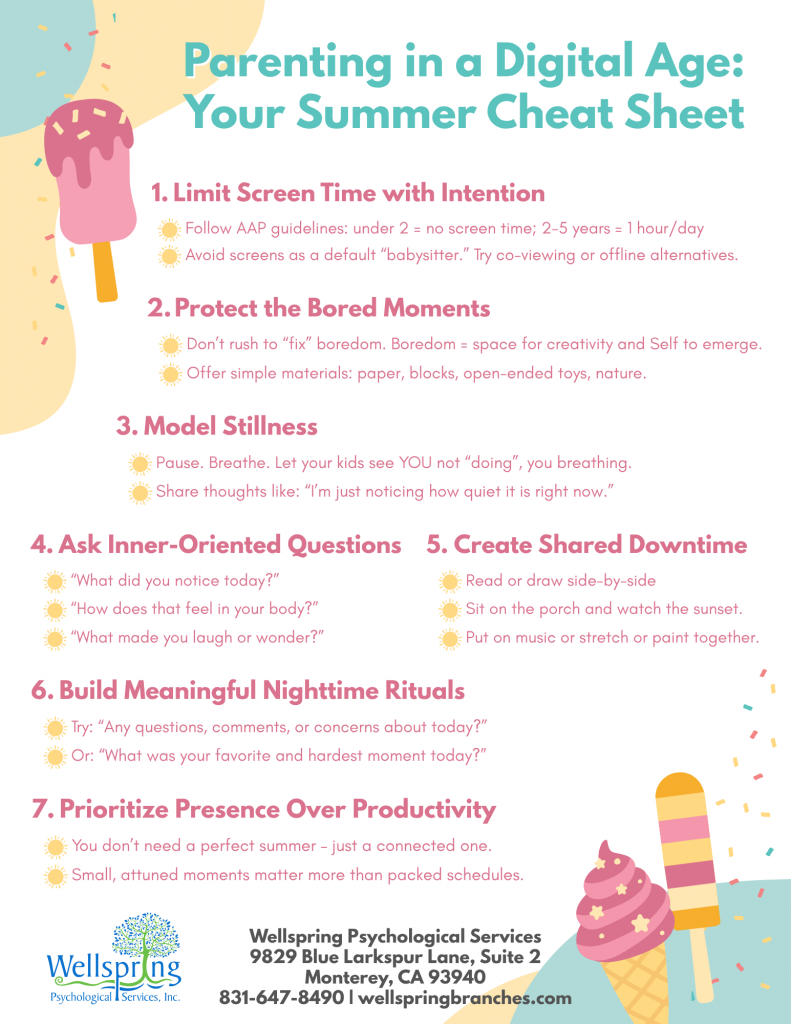
- Shared Quiet Moments: Sit together without a screen. Read books. Draw side-by-side. Listen to music and do nothing else. These simple moments signal: your presence matters more than productivity.
- Open-Ended Questions: Invite reflection. “What did you notice today?” “What made you curious?” “How does that feel in your body?” These questions encourage children to look within rather than constantly respond to external stimuli.
- Nighttime Reflections: One of my favorite rituals as a parent was asking, “Do you have any questions, comments, or concerns?” before bed. It created space for feelings to emerge—unprompted, unfiltered.
- Unstructured Outdoor Play: Let them run through the sprinklers, dig in the dirt, or find bugs in the backyard. It doesn’t have to be elaborate. What matters is the sense of freedom and embodiment.
- Creative Boredom: Don’t rush to fill their days. Let them say “I’m bored”—and don’t fix it. Give them basic supplies—paper, crayons, cardboard, blocks—and see what unfolds.
- Modeling Mindfulness: Children learn how to be with themselves by watching us. Take moments to pause, reflect, breathe, or journal. Even narrating your own experience (“I’m noticing I feel tired and grateful today”) shows them how to tune in.
A Final Thought
It’s easy to feel pressure to optimize every moment of summer. But in truth, it’s the quiet, unscripted moments that leave the deepest imprint. Our children don’t just need stimulation; they need stillness. They need to know themselves outside of what they do. The more opportunity they have to be in the now, the greater their engine will be to dream, create, and expand into their future.
This summer, may we create just enough space for boredom to become possibility, for stillness to spark Selfhood, and the pause to be nothing more than a curious child.
Bonus: Summer Parenting Cheat Sheet (click to download)
References:
- American Academy of Pediatrics. (n.d.). Screen Time Guidelines. Retrieved from https://www.aap.org/en/patient-care/media-and-children/center-of-excellence-on-social-media-and-youth-mental-health/qa-portal/qa-portal-library/qa-portal-library-questions/screen-time-guidelines/
- Paulus, F. W., Ohmann, S., & Popow, C. (2023). Relations between Video Game Engagement and Social Development in Children: Executive Function as a Mediator. Frontiers in Psychiatry, 14, 10604845. https://doi.org/10.3389/fpsyt.2024.1407703
- Child Mind Institute. (2024). The Benefits of Boredom. Retrieved from https://childmind.org/article/the-benefits-of-boredom/
- Twenge, J. M., Haidt, J., Blake, A. B., McAllister, C., & Lemon, H. (2023). US Adolescents’ Religious and Spiritual Beliefs: Links to Screen Time and Mental Health Outcomes. Journal of Adolescence, 101, 1–15. https://doi.org/10.1016/j.adolescence.2023.04.003